In Search of Myself
The setting is virtually silent. Save a gentle gurgle where river water pours over a log jam and the cold rustle of January wind through cypress and disrobed willows, there is quiet. But that is good. There is far too little silence in this world.
I am looking for wood ducks. The drone of that tiny outboard that propelled my passage to this spot had caused a steady eruption of woodies. They burst from clear waters at every bend and tangle, their high-pitched squeal filling the air, those gaudy colors flashing in a winter sun. And now I am at Jennings Hole, the exact locale that marks my beginning as an outdoorsman.
And then there is the smell. It is pungent but pleasant. It comes from the mud and decaying debris left behind by high water, and its sting pushes me back to childhood. I recall stories of the Jennings Hole, tales that came from my dad of the days he lived on the bluff above the river and unearthed stumps and plowed mules in cotton patches that then filled the flat, rich earth. I don’t recall the first time he took me there; I was a young child. But it was important to him that I know, that the history and the river become a part of my being. This happened, completely.
However, I do recall that warm May morning he took me in a cypress boat to Jennings Hole and handed me a cane pole. There was a goose-quill bobber and diminutive hook and split shot on the line. The cricket had barely hit the water when a belligerent bluegill attacked. This battle was long, but the bream eventually plopped to the boat’s bottom. I was enthralled then and am now at the memory.
Reverie is disturbed by the hiss of wings. I blink away tears that I credit to the cold and see a woodie drake and duet of hens. I pull a battered A-5 to my shoulder and the drake splashes to the rippled surface. Even in this posture he is magnificent. Recall enters a second time.
I see my dad sitting close to me, his tan and tattered shell vest over a worn denim jacket. “He’s right there,” dad whispered as he pointed out a squirrel in a double-trunk pine on the bluff. The bluff and pine are still here, just as they were then. The .410 popped. The river and its surrounding had again worked their magic.
I sit here and admire the drake that I have just taken and realize that I was not seeking ducks this morning as much as I was seeking self. I found what I had gone after.
At times I think my blood is diluted with that river water, made richer by its flow. And while it may seem morbid, I don’t think I would mind if my ashes were scattered along the Pearl when that time comes. Seems only fitting, for a river, that river, runs through me.

Simple Therapy for the Tattered Spirit
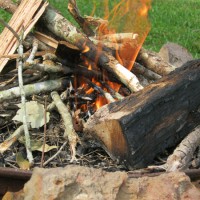
Truth be known, we all probably need a little therapy now and again. Not therapy that focuses on strengthening repaired knees or stretched shoulders, though this is essential in various situations. The therapy we often need is that which weaves back into place spirits that have been tattered. This tattering can come quickly, as in times of sudden loss. But it can also creep in subtly after extended periods of excessive demands on our time and abilities. However it arrives, arrive it will.
While I didn’t fully realize it then, I know now that I discovered in childhood a powerful entity that never failed to work its therapeutic magic. This marvelous little thing was a campfire, and its efficacy remains.
In those early years, a campfire was a near constant for country boys such as I. We camped regularly, perhaps two or three nights a week – out in the pasture or down by the creek after chores were completed in the afternoon. Simple affairs, these camps. More times than not just a quilt spread out on the ground. But there was always a campfire.
Let it be firmly established here that a fire is not some curious addition to an outdoor experience. It is mandatory, vital. True, there are times when a fire is not permitted because of prevailing restraints, but if these are not factors a fire simply must be. It becomes the centerpiece, not an ornament. Why? That likely varies from individual to individual, from circumstance to circumstance.
A campfire – even if there is no literal camp – is the point of gathering. Participants yield to its lure. Someone may do a bit of rudimentary cooking, but more than likely everyone will just sit and stare, those stares broken by jovial or somber conversation. There will be laughter, perhaps even tears.
Sitting around a campfire permits one to become transformed, almost as if the world outside that gentle glow of light does not exist. Maybe that is the primary therapeutic element, this transformation that for the moment shuts out all else and bandages those ragged edges of the heart so that they may more quickly heal.
A campfire’s coals are mesmerizing. Their enchantment allows the silent observer to probe distant depths of his or her mind, depths that are seldom explored. Those varying hues of orange, blue, yellow; that little spot that jets flame out to the side; the hiss and crackle; an orchestrated yet spontaneous dance; the warmth on your face that at times approaches too much but pulls you close just the same: All are present there in the coals. All are hypnotic. All are healing.
The smell: It is unmistakable. The modern world may tell us to avoid such odors as those emitted by a campfire. And perhaps these are ill placed if we are dressed for the office or business conference. But taken for what it is and in its proper setting, the smell of a campfire is a primal badge of honor. There was a time in the not-too-distant history of humanity when that smell meant comfort, safety. My perspective is that it still does. The smell represents a basic ingredient for life and should not be dismissed as antiquated.
And consider the process of a campfire. It mimics life. One form of matter is placed onto the coals to be in large measure used up, to provide its heat and light. Another form of that matter is not consumed and spirals skyward toward freedom. That in itself prompts contemplation. And all these can be found in a campfire.
 Tony Kinton is a native Mississippian, where he grew up on a small farm. Hunting and fishing were regular parts of his life, and these pursuits produced much of the food found on his family’s table. Read more here...
Wagon Road Trilogy
Book 2