
Cape Buffalo The Rifle
Cape Buffalo
The Rifle
Hunting Cape buffalo is a particularly intensive enterprise. These animals are captivating and challenging. Even if a hunter has not pursued these bovines, he or she has likely dreamed about it, perhaps lived the experience vicariously while reading magazine articles or watching outdoor shows. If not the apex, buffalo are near that designation in the minds of many. That thinking is justified.
Much thought goes into the rifle that will be used for a buffalo hunt. This is wise, for these beasts can be unpredictable and tenacious of life. Danger is ever present while in their company. Most career buffalo hunters and/or PHs opt for medium to big bores for this chore. Calibers in the .375, .416 and .458 range are popular, with some of more persuasion being employed by those who are responsible for their hunter clientele. A judicious PH may have along a double in .470 NE or something similar as a “stopper” should the situation turn sour. Good thinking, all these.
When I began planning for my buffalo hunt, I did a great deal of research regarding appropriate calibers. The .375, in either H&H or Ruger, teased my attention. I like the .416 Remington and gave that a great deal of thought. But having little need for any of these or even larger rounds apart from what might be my only use of this particular rifle, I continued that research. Something that could be used for game such as elk or even whitetails held a measure of appeal. Enter the 9.3X62.
The nine three, as it is commonly called, is quite common in Europe and Africa but not so much in the U.S. However, the popularity of this round has begun to grow among American hunters and can be expected to show up more frequently in gun stores and hunting camps. This little gem performs far out of proportion to its size and is simply too good to miss for a hunter wanting a big rifle that is quite user friendly. No, the recoil generated by the 9.3X62 is not a walk in the park, but it is tolerable. The thump of this round lies somewhere between a .30-06 and .375 H&H in rifles weighing 8.5 and 10.5 pounds respectively. A 9.4-pound nine three, as is mine, is manageable for anyone who will take some time to shoot it.
The nine three was developed by German gunsmith, Otto Bock. Such a cartridge was requested by German farmers in Africa who needed a powerful tool for the biggest of game, yet one that was affordable and could be built on the reliable and available Mauser action. British guns of viable calibers could be had, but these were much too expensive for most of those farmers. The 9.3X62 arrived and saved the day, as it were. It went about doing its asked-for chores with little fuss and fanfare. It worked then and still does.
Before settling firmly on the nine three, I checked with my PH. He then checked with another PH, and so on. Reports were positive. Put the shot where it should go and the little rig will accomplish the task. But that putting the shot where it should go is a given, regardless of caliber. So it was the nine three that I would use. Next came the acquisition.
There were not a great many choices when I began shopping. A sporter here and there but all right handed. I am a helpless lefty and insisted on having the bolt handle in the proper place, so it quickly became apparent that a custom build would be necessary. It was then I contacted my writer friend Bryce Towsley. He has his own shop behind his house in Vermont, and he agreed to take on this task of fabricating a left-hand 9.3X62. He insisted I come join in for the project, an invitation I gladly accepted. As it turned out, I was simply the “here-hold-this” participant, but I became quite good at that before the build was complete!
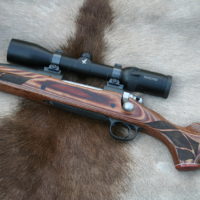
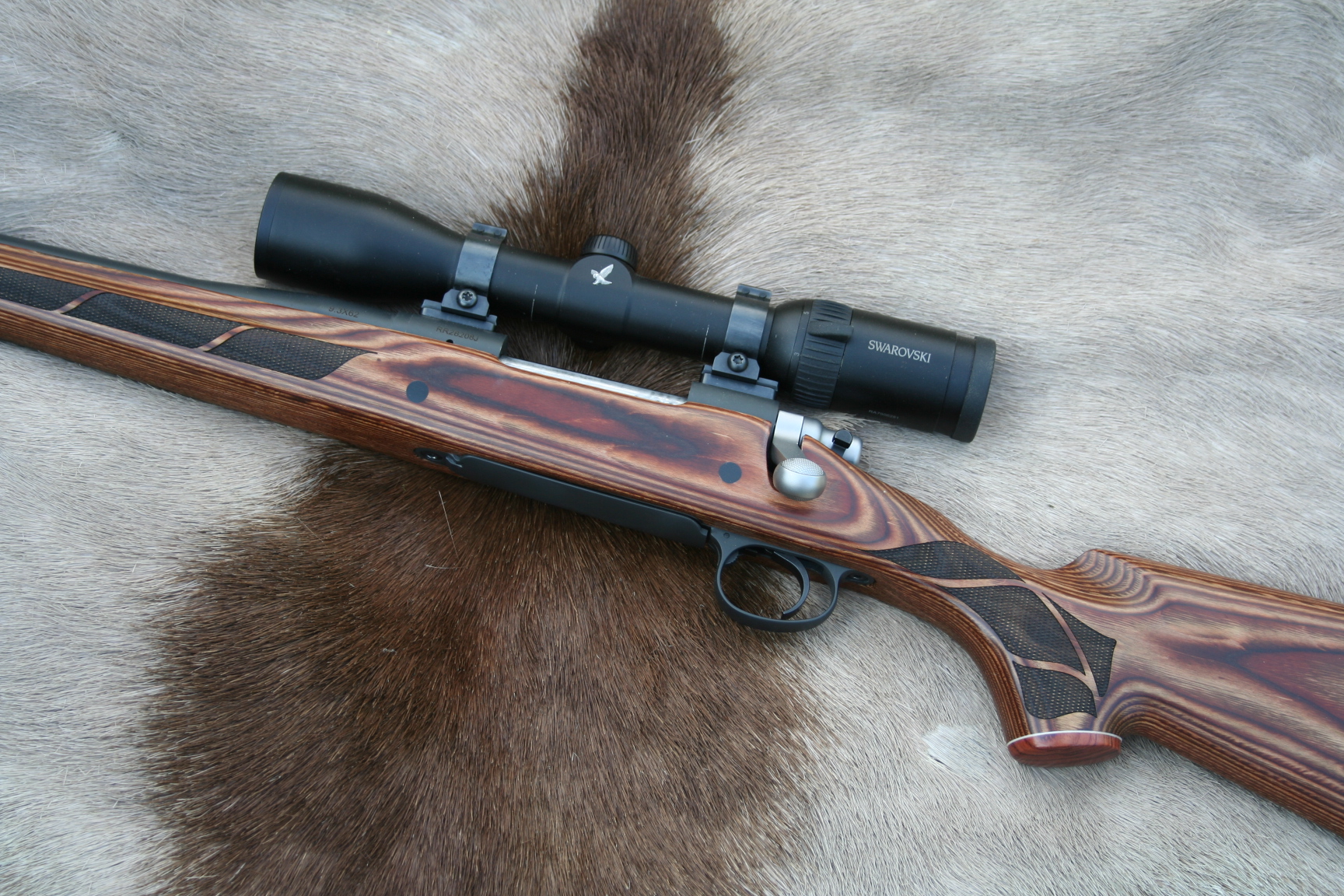
I began collecting needed ingredients: action, barrel, stock, trigger, rings and bases, scope. Action: Remington 700 LH; barrel: Shaw; stock: Boyds Gunstocks laminated hardwood stock in the Classic style; trigger: Timney; rings and bases: Talley; scope: Swarovski Z6 1.7-10X42. We were ready to go.
After the rifle was finished and I got back home, I began developing loads. Since this would be first used on Cape buffalo, I wanted the right bullet and a load that would push that bullet to a solid velocity without pressure issues. There was no question regarding the bullet; it would be the 286-grain Barnes TSX. With Norma cases and CCI 200 primers, I began experimenting. The load I settled on was with H4350 powder. It shot MOA and gave an average velocity of 2,479 fps.
The completed rifle was and is to my liking. In fact, it is my favorite of all I have and performs wonderfully well. And it is handsome. The appearance is particularly enhanced by the Boyds stock. I like the nutmeg color and stripes created by lamination. It boasts just the right amount of engraving, a tasteful nose cap and a generous recoil pad that mitigates the kick. This stock and the rifle it houses fit me perfectly. I made the right decision, and a nice Cape buffalo and impressive warthog speak of the rifle’s capabilities. 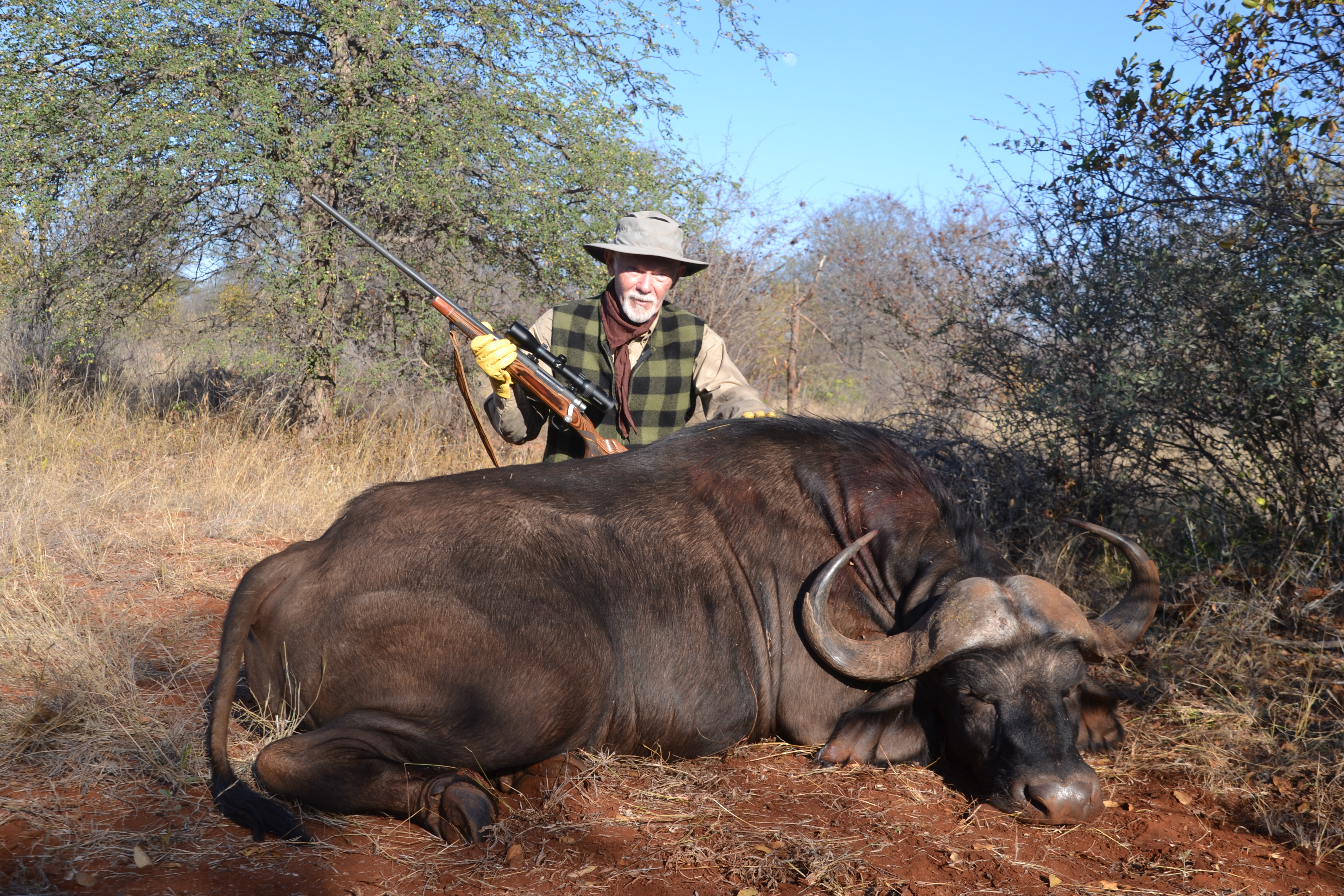
A Sharps in Africa

A Sharps in Africa: The Highs and Lows
The Milky Way was at arm’s length, asking, it seemed, to be brushed by feeble fingertips that tingled in a night chill. On the edge of that expanse was the Southern Cross, a marvel of nature and symbol of tranquility. I stood in reverent awe, allowing this scene to sink to my very core and bring refreshment from a dour mood that had consumed the day just ended. There was some transformation as a result, but tranquility didn’t immediately become the overriding emotion.
The evening in question closed the third of a five-day hunt in South Africa. I had booked with Louis Steenkamp (www.sofalasafaris.com), as I had the previous year. That adventure had been near perfect, and I was able to collect a fine nyala bull while using an Osage selfbow and cedar arrows. I had hoped for a similar experience on this trip, but nothing had worked out as desired. For three days gusty winds had battered the bushveld, the only constant being their variables. From the south one minute; from the north the next. And between these, the east and west were not neglected. The scent of hunter and PH permeated every inch in every direction. Game was locked down.
And to make matters even more complex, abundant rainfall during May held this June expedition captive. Leaves that should have littered the bushveld floor still clung tenaciously to branches, creating a veritable curtain that hid with certainty any creature that might be there. Even the waterholes were sustaining precious little use during daylight. Two days remained, and here I was beneath that glorious sky, looking upward for solace.
Louis Steenkamp is a true gentleman. I have known him for years, and he has visited my home and trophy room on more than one occasion. He was sympathetic and understanding of my situation and offered encouragement. However, if things didn’t change soon, I stood a reasonable chance of leaving Africa with all my black-powder cartridges unfired.
I recall those early meetings with Louis and how he was intrigued by my rather antiquated methods of doing things. He fondled the homemade stickbows I use and practically melted with glee at the heft of my C. Sharps Bridgeport in .45 – 2-1/10”. Plans for future hunts began then, and in 2013 the nyala hunt came to be. While on that safari, he and I concocted the one we were now on. This one would be done with the Sharps, a zebra and waterbuck being the primary species of interest.
And I had seen both. Fleeting glimpses through the bush. I had also seen gemsbok and wildebeest at two different waterholes while sitting in a desperate attempt to gain a clear shot at either of the two I sought. I had the gemsbok and wildebeest from my first hunt in Africa, so they were of no interest other than the majesty they exemplified in this monstrously perplexing land. Not an insignificant matter, this majesty, but not animals I opted to collect.
The next day showed some improvement, with winds abated to a degree. We elected to sit a waterhole early on and move about the bush as the day aged. Only minutes before we left that blind, off in the distance something was twisting and creeping through thick cover. A jackal. I was instructed to take him if the opportunity arose, so I made ready for the shot. A jackal was hardly a test for the black-powder load, but he would require precise shot placement, this on a small target. When the canine closed to within 50 yards and reached a spot clear of brush, the Sharps rumbled and the jackal crumpled. Not a zebra or waterbuck but a shot well made. I was pleased. Then the winds renewed their vigor.
With all this mention of black powder and loads containing such, there are certainly viable questions of how this was accomplished. Flying with black powder, whether loaded or in bulk, is not allowed. In fact, attempting to do so is a sure recipe for some serious legal issues. It simply must be avoided, regardless of the gymnastics attempted to cover the infraction.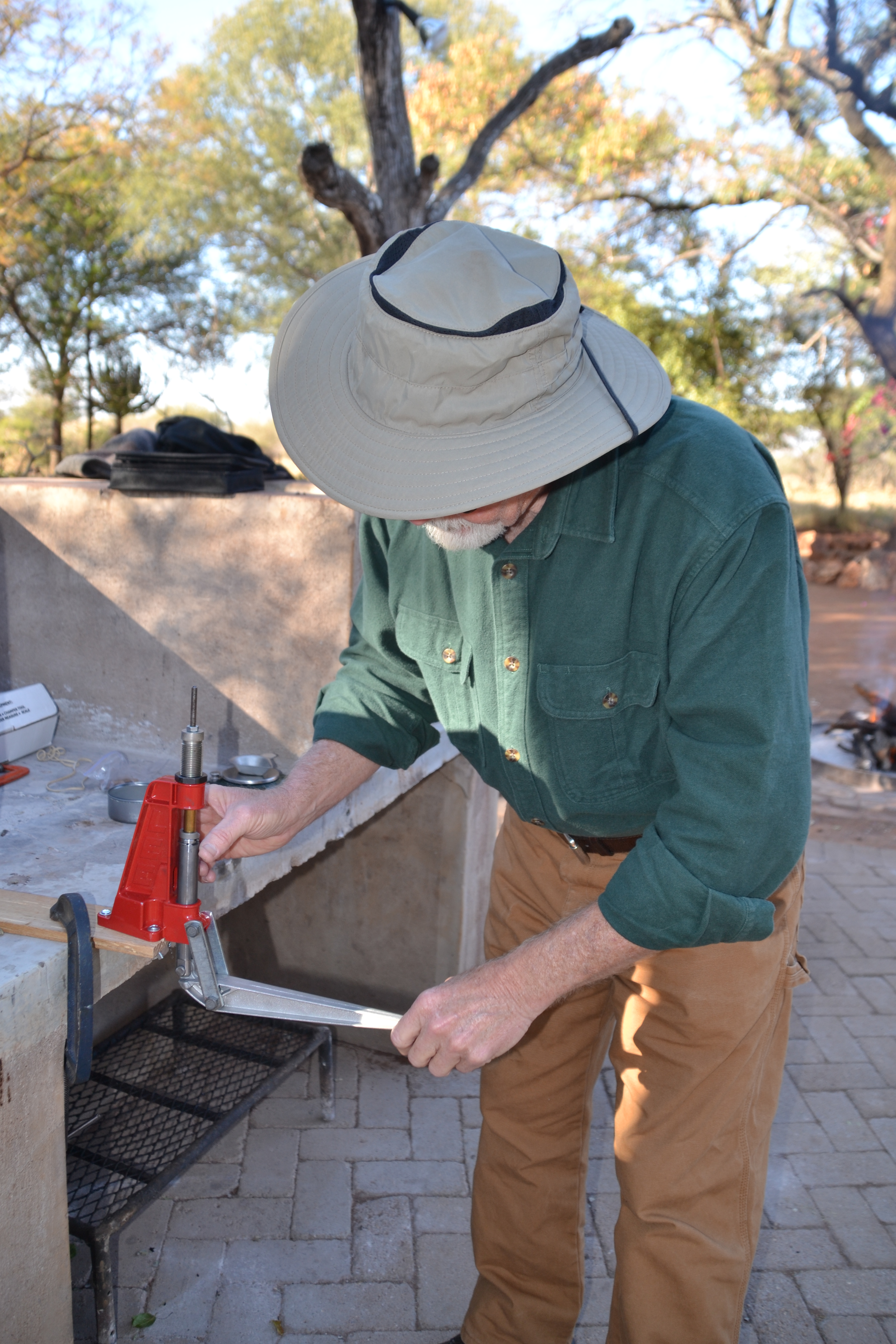
After a great deal of discussion via email and phone with Louis prior to the hunt, he discovered that South Africa had a provision that allowed a PH to acquire a one-use permit to purchase and transport black powder and primers for client use. That fit my needs perfectly. Louis eventually sent me a picture of him holding a can of Swiss 1-1/2 and a box of Federal 215 Magnum Rifle Primers. The remaining chores became mine.
I ordered a small Lee press from Midway. This I fit to a thin oak board with bolts and wing nuts. Louis had “C” clamps available, so this unit could be attached to a concrete ledge near the patio at Sofala’s lodge. I prepared the cases here at my reloading station and packed these and the cast bullets I had made and lubed with SPG. Cases and bullets – unloaded and properly packaged – create no problems with the airlines. I did declare them but was quickly given the go-ahead.
Also in the packing were John Walters .060 wads, a section of copper tubing flared on one end, a small oak holder for the tube, a tiny brass funnel to be taped to the copper, an RCBS electronic scale and a box of dies consisting of a compression, seating and taper crimp. A cheap metal spoon was thrown in the mix for the purpose of transferring powder onto the scale. I must admit this makeshift reloading contrivance worked to perfection. The first load fired punched the eight ring dead center elevation at 100 yards on the trial run.
Before I realized it and certainly before I expected it, I found myself on the last afternoon of this particular hunt. With emotions increasingly frayed and disappointment hovering about me in a smothering cloud, Louis and I went to an elevated blind near an aging cattle pen left over from ranching on Sofafa in the 1960s. A water tank was in the distance; wire fencing rusted and sagged in solemn reflection of days past.
A plus this spot afforded was open brush. Things weren’t as tangled and cluttered as in most areas, and the possibility of seeing game move about was enhanced. A ranch road made a 90-degree beside the blind, so enhanced visibility was accomplished. The final vigil was underway.
And there he was, creeping silently along a drooped fence and making his way toward an opening of rich, red African soil. An Impala ram. Not one for the record books, but a mature specimen just the same. I care little for record books.
Each time he would look away or put his nose toward the ground, I would inch the Sharps into position. When he looked up, I dutifully stopped, frozen in the moment. At a solid opening and with the Sharps properly set, I touched the trigger. A great rumble reverberated across bushveld and a putrid blue/grey cloud of smoke obscured the view. Still, there was no doubt of what had happened. That whump of bullet strike told the story. The ram lay motionless, grand even in this terminal posture. I crept from the hide, walked to the ram, removed my hat and offered a prayer of respect and thanksgiving. The sun was now an orange phantom beneath thick bush to the west.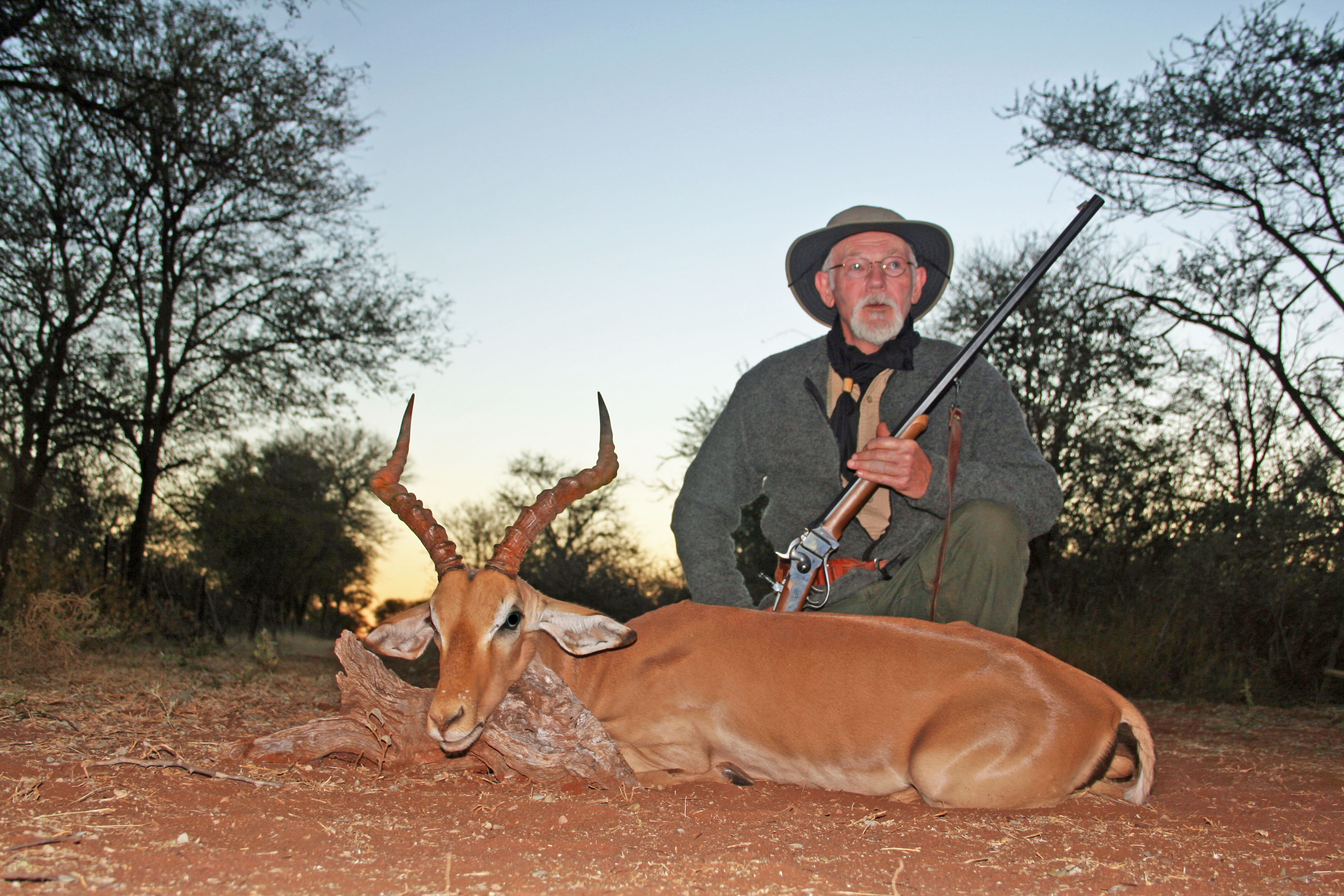
That night I again revisited the Milky Way and Southern Cross. My heart was light, filled with gratitude. The only somber emotions were triggered by the reality that I would leave this land of magic the following day. Next year, the zebra and waterbuck and Sharps.
And next year came! May again, and again some of the same frustrations faced a year back. Rains had been persistent, and vegetation was thick and lush. Not ideal for sneaking about in search of game. Louis had secured the powder and primers from the previous year, so I planned to do things in similar fashion as I had done before. But there were changes.
One was the addition of an MVA Model “B” scope. Already aging eyes had grown a year older, and I was having difficulty with the tang sight and blade front. I could and did still employ these units, but I opted to try the scope. It was and is amazing. The MVA tube will remain a permanent fixture for hunting with the Sharps.
Some other modifications came in the loading process. I had used the Lyman 457193 on the jackal and impala, as well as on whitetails and wild hogs here at home. It is a reliable hunting bullet. But I wanted something with a more pronounced meplat and increased weight. This project began with the Lyman 457125. The round nose of that bullet would be adapted to a broad meplat if possible.
My friend Neal, who is a consummate tinkerer and dedicated black-powder shooter, suggested we cast some bullets from the 457125 and attempt to judiciously remove a part of that bulbous nose. We did this by wrapping the grease groves in masking tape and gently putting the bullets in a lathe. We marked the nose and carefully chiseled that nose to desired proportions. Results were more than positive. After weighting and inspecting some of the modified bullets, we found that we were consistently producing projectiles with a wide meplat and average weight of 485 grains. Trial runs with SPG-lubed bullets ahead of 68 grains of Swiss 1-1/2, .030 Walters wads and Federal 215M primers worked perfectly. I had my combo.
One other thing I wanted to try, this in an effort to take as little loading gear as possible, was to simply load cases minus weighing the charges and skipping the drop-tube procedure. I did this by weighing 68 grains of Swiss and pouring it into a bulk measure customarily used in loading my flintlocks. With the measure set at that increment, I placed a brass funnel into the prepared case and poured slowly from the bulk measure and into the case. Again, positive results. I would not need scales and drop tube, a plus when packing sparsely for air travel. Forty prepared cases and as many trimmed and lubed bullets, along with a brass funnel, measure, Lee press and dies accompanied me to Africa.
Things progressed slowly the first four days – that is if collected game is an indicator. Zebras scurried about thick brush, hoof beats on red soil the only proof they were ever there. One particularly handsome waterbuck led us on a full-day sojourn through thorns and along two-tracks without so much as an anticipated shot. And there was even one of the striped marvels that almost played his hand poorly. He stopped within range, but offered nothing but hind quarters protruding from tangles. I guess he played that hand wisely after all. We kept at the chore; time was slipping away. And then the shot I had waited for.
On the next to last day, Louis and I were sorting through bushveld clutter when we heard what was no doubt a collection of zebras running right to left. Louis dutifully and spontaneously set the sticks; my Sharps found its place there. Five or six equines zipped past, never pausing to give additional study to whatever it was they were running from. What they were running from didn’t matter to me, and apparently not to them. What did matter was that it seemed the entire group had gotten by with no shot offered. But then there was another and perhaps even another in addition to that one, there off in the distance but still on the right path.
That anticipated moment came quickly. One zebra stopped behind thorn bush, his entire posture one of energized muscle mass and wondrous striped beauty. A tiny opening was there, the Model “B” settled and the Sharps thundered. Time stopped. But it didn’t stay in suspension long. The zebra that was the object of my attention bolted. Still, it was immediately obvious that he would not go far. Knelling beside that magnificent creature brought again to my heart and mind a deep sense of gratitude.
Nighttime found me staring again at the sky, words of thanksgiving drifting upward. Tomorrow I would make ready for the trip home.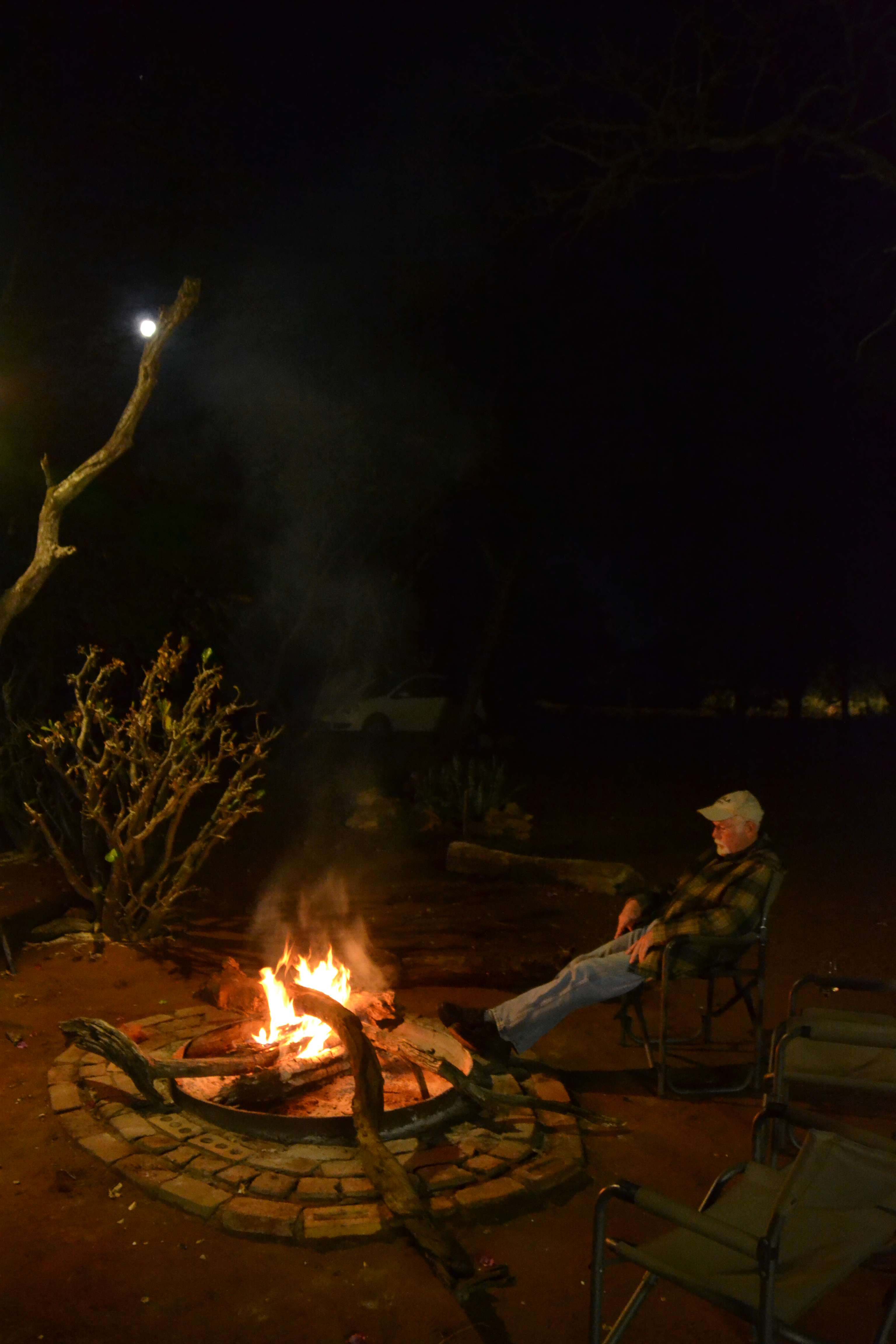
Lonesome Journey: A Properly Conducted Method Hunt
The journey is often a lonesome one. Seems there are few who choose to follow those sometimes anxious, difficult steps toward success in the hunting fields when the very outset is plagued by obstacles, obstacles that are perhaps only perceived because of a marked absence of modernity in equipment. These who are reticent to join in are victims of the high-tech, are convinced that every trinket and anything new is essential. If that success mentioned above is judged fully by game taken, there is some validity in such thinking as that exhibited by those who neglect the finer nuances in favor of the latest devices.
Success, however, is not solely taking the biggest or most when hunting is the selected path. Success is considerably more complex, something that reaches to the core of one’s being and is determined by that one and that one alone. A look at method hunting is a viable beginning.
This can be a great many things, but it certainly has become associated with employing elements of the past. Moving from compound bows to recurves or longbows or even to more primitive units such as selfbows constitutes method. Such a move brings with it intrinsic obstacles. Or more accurately stated, brings with it an enhanced challenge. Sensible range is, in most instances, suddenly reduced by 10 yards or more. And there is that factor of skill. To adopt the method of traditional archery rather than the modern contrivances demands skills that can require a protracted amount of time to master if one is to be ethical and efficient. This mastering, however, is simply one of the layers of complexity defining success.
 Consider for a moment moving from modern rifles and shotguns to muzzleloaders, another approach toward method. One can stop short at that destination of meeting legal requirements when dealing with these tools. There are more than a few muzzleloaders that meet the criteria set by legislation, which stipulates only that the firearm be loaded from the muzzle. But these remain more or less modern firearms – scope sighted, powered by substitute black powder and shotgun primers, casting completely modern projectiles often riding the bore in a sabot. Still, a method one must suppose.
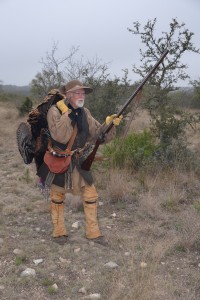
But go farther. Plunge into the depths of muzzleloading, and all those ingredients just highlighted vanish, replaced by open sights, round balls or loose shot, genuine black powder, percussion caps or flints. Each step back creates its own set of potential difficulties, generating a greater challenge that tugs at the heart of one who is determined to see if he or she could have survived in those days of antiquity. The choice to do so or where to stop in history is again personal. But whichever is embraced, it practically shouts “Properly conducted.” This portion, the properly conducted, is another layer of success, and peeling it away diminishes the reward, even removes properly conducted from the equation.
It seems an affront to any backward journey to take along ingredients that were not common to the selected era. Camo, while clearly effective, molests the sanctity of a flintlock rifle. Modern ground blinds disturb sensibilities when pursuing the grand and gaudy wild turkey, while toting a long-barreled fowler. Decoys are best left behind, along with mass-produced calling devices. Put in their place more obscure parcels: hunting skills, patience, a willingness to go home minus game. Success, then, takes on a subliminal and substantial meaning filled with essence, intrigue, romance, wonderment. This mindset will demand and encourage a properly conducted hunt. Success, at least those obscure but nevertheless essential pieces of the whole, will expand exponentially, realized and celebrated by the one who exercises the discipline and resolve to conduct the entire episode in proper fashion.
Yes, there will be those who don’t understand, even criticize, refuse to give credence, perhaps leaving the participant feeling as if a lonesome journey has just unfolded. But the one who experiences it all and knows the truth of the entire process will come away enriched, empowered.
And when that one does collect the game pursued, that one will then possess a full grasp of what success is truly all about.
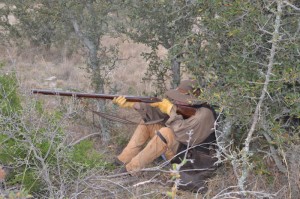
Africa Revisited
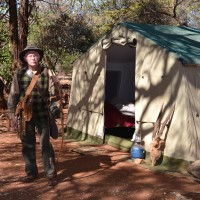
Limpopo Province, South Africa. Bushveld. Land of the acacia and baobab and wait-a-bit thorns. A place time has neglected, where bird call serves as alarm clock, where the human intruder can lie awake nights as baboons scold from their koppie and treetop dwellings at a leopard beneath. A place where that same human can brush the Milky Way with feeble fingertips while a campfire performs its perfect ballet, can see the Southern Cross vividly suspended in lucid skies.
The province derives its name from that river bearing the same: Limpopo. It forms a boundary between Botswana and South Africa. Zimbabwe and Mozambique are not far to the north – at least not far in African terms. It was here, in this land of protracted and monstrously perplexing mystery, I concluded years back that experiences are the finest form of wealth. I was now again inextricably bound by its intoxicating marvels.
We first spotted the nyala bull from our truck while changing locations on the concession. Red dust boiled from a ragged ranch road as we stopped to allow my PH, Louis Steenkamp, an opportunity for closer scrutiny through his binocular. Petrus, the tracker, sat quietly as Louis whispered instructions in Afrikaans to his brother Marinus at the wheel. I determined from the animated gestures that a viable chance for stalking was available.
“Do you want to try for this one?” Louis quizzed me in that fluid and beautiful South African accent. My response demanded no words, for evidence in the affirmative was given by a hasty gathering of quiver and bow. Simultaneously, three of us stepped from the truck and onto African soil. I fell in line behind Louis and Petrus. What at that moment could possibly become a quick end to the hunt eventually morphed into a series of events that were filled with discouragement and elation.
The evening before, several of us sat around a fire and talked hunting. Nyala became the centerpiece of that conversation, and Martinus coaxed us toward wonderment with his review of a Zulu legend regarding this grand animal.
According to that legend, all the spiral horns became involved in an argument, this focused on which among the various species was the most beautiful. Each would opine in expected fashion: “We are,” so said the eland. “No, it is the kudu,” a member of that fraternity added. “Impossible,” noted the bongo. “We are the most striking of them all.” And so it went. With no solution reached, the animals petitioned God to come down and settle the matter.
God obliged, and arranged all the spiral horns into a side-by-side line, along which He walked back and forth, admiring each individual. It is said that God finally stopped in front of the nyala, nestled the bull’s face and head gently in His hands and proclaimed, “You are the most beautiful.” The place just below the eyes where God’s thumbs rested became that glorious white chevron. And where His fingertips touched along the jaw lines became those white spots. I could offer no credible argument with this tale, for only God could create such a grand and handsome creature as the nyala.
And on the afternoon prior to this fireside enlightenment, serendipity took place on another concession. We were on an errand to retrieve a huge warthog taken an hour earlier, when an aging tracker stopped and motioned to the ground. The spoor to which he referred was all but invisible, that is until he pointed it out. Louis interpreted. It was leopard dung that revealed the cat had been feeding on kudu. Evidence was ample, this supported by multiple pictures of two outsized leopards on game cameras.
That evening, after the discovery of leopard spoor and the sharing of marvelous tales from the African bush, I went to the tent and drifted off to sleep with hopes of hearing guttural grunts of this most intriguing of all felines. Being separated from a leopard by only a canvas wall is the stuff of dreams.
We made profitable progress in our stalk toward the nyala. The wind was right and heavy brush afforded ample concealment. Slowly and deliberately, we continued. I nocked an arrow. But then, with no provocation other than his own whims, the bull moved – maybe 100 yards and to another acacia cluster, where he busied himself with more leaf munching. The process had to stop so that a new stalk could be planned.
And so it was. This one, however, ended as the one before it. Two more times it happened. The sun was now beginning to cast haunting shadows and a chill had returned to the African air. Day four was coming to a close. This nyala could be slipping away, as were the remaining hours of the hunt. But then a sudden change. With Petrus holding back in the brush, Louis and I found ourselves within 20 yards of the preoccupied bull. It was time for a shot.
Most hunters recognize fully a new arrival that shows up about this same time within the completion of a chosen goal. It is a sentiment apart from target panic or buck fever or whatever you opt to label it; it is something more. It is not the question of whether or not the shooter can make the shot. I was confident of that fact. The question is and was: “Do I want to do this?” Such a moment seems ill placed after so much practice and expense and travel and distance, but there it was. That ache, that uncertainty. Time comes to a halt and the hunter, at least this is true for me, finds himself or herself in a bubble of anticipatory grief, its rough edges not yet sanded smooth by exhilaration.
But that hunter must choose; in this case I must choose. I could draw and release the arrow or I could simply smile and walk away. There would be rewards in either selection. I do not recall when the decision became firm, but I do recall the sight picture and the anchor and the realization that I was about to deliver meat to those who needed it badly and I would in the future be afforded the distinct pleasure of looking at the fingerprints of God on my wall. No recall of the release, but the arrow, without notice, smacked solidly into that pocket just at the upper knuckle of the front leg, behind which lay the heart. There would be no need for a tracker.
As I approached the bull and made certain that the end had come with haste and certainty, Louis and Petrus waited from some distance back. They gave me the freedom to experience this entire episode in any manner I elected. For they, too, are hunters; they have felt the sobering sadness mixed to perfection with elation. There would be no high fives or senseless jubilation, though there was quiet satisfaction more than evident. I removed my hat and knelt in a long prayer of thanksgiving. Once again God had blessed me, Africa had embraced me and all was well with the world.
Tents: Structures Good for the Spirit
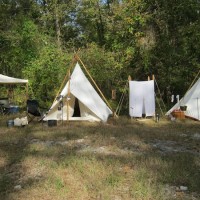
I always sleep best in a tent. Few there are, or so it seems, who share this possibly misplaced enthusiasm, but for me there has never been any question. I always sleep best in a tent.
Why that is so I cannot say. In fact, I am not completely sure. Perhaps the reason trails back to some Bedouin spirit of being mobile or some Bohemian propensity to be something or someone who shuns conformity. Could be, but these traits appear a bit radical for me. You see, I am fully domesticated in most of life. But there remains a strong urging that places me in a tent many nights in any given year. Not as often as I would like at times, but these wilderness wanderings are numerous. A tent is home during such sojourns.
My infatuation with tents and other similar canvas structures goes back to childhood. I fashioned overhead contrivances from practically anything I could find lying around. And I slept in some of these. I actually got my first real tent when I was 12. It was a pyramid rig with a big flap door that could be stretched into a canopy. This unit served me well and was regularly packed with squirming and excited young boys camping in the pasture behind our barn. Grand evenings these were, with us curled under quilts dragged from the house, the sweet aroma of grass drifting up to comfort us. That grass served as our mattress. I have not been without at least one tent since.
When I look into this captivating lure I have for tents and attempt to analyze it to some degree of satisfaction, this in an effort to confirm that I possess a measure of sanity, I must admit to a much-maligned need for escape. There are scoffers at such thinking and practice, you know. I simply listen quietly to them and then go spend a night in my tent.
And do I come away from these mental ramblings and searches for purpose convinced that I am indeed sane? Certainly! I am more persuaded each time I do so. And that generates even more desire to set up a tent.
There are also sensory stimuli common to tent camping that are far more concrete than some obscure need. More tangible, if you will. There is beauty, this coming in large part through symmetry. When I set up camp, or more appropriately when several of us similarly- afflicted individuals set up camp, we strive for symmetry, organization. No hodge-podge of scattered items; everything has a place. And all looks pretty much the same: White canvas tents and cook canopies. Each in its designated spot, evenly spaced from another of its kind. All supported by peeled pine poles, not aluminum or fiberglass.
There are blacksmith-made fire tools on which hang buckets and pots, these tools and the blacksmithing courtesy of my friend Neal Brown. There are also ornate masts, made by that same blacksmith, that hold candle and oil lanterns. And while the odd folding chair or table from a big-box store can be seen now and again, the gradual switch to hand-made oak furniture and cypress cook boxes is near complete. This is all quiet, natural beauty that refreshes the battered spirit like nothing else can.
And then there are the sounds. No better way can be found to listen to a cricket chirp or an owl hoot or a coyote yap. Some of these, such as the chirping cricket, may be only inches away from the ear that hears it. But it is still removed by a canvas wall and holds no threat of taking up residence in your sleeping bag. These sounds, all common to night, lull me off to a pleasant and relaxing state that is too often hard to acquire otherwise.
Come daylight the sounds change. But they are abundant just the same: A squirrel barking or shaking a limb, loosing dew drops that spat gently onto the canvas dwelling; a turkey gobbling in the distance; a deer blowing and stamping in disgust at the hulking white edifice and the noxious smell of humanity; wild geese on a morning sun en-route to some faraway environ; the brisk, sharp chirp of a cardinal in search of breakfast. A tent is perfect for absorbing and enjoying such sounds.
Perhaps these are some of the reasons I remain enamored of tents. They are good for the spirit. Day, night – each is equally enchanting. And I am once again reminded that I always sleep best in a tent.
 Tony Kinton is a native Mississippian, where he grew up on a small farm. Hunting and fishing were regular parts of his life, and these pursuits produced much of the food found on his family’s table. Read more here...
Wagon Road Trilogy
Book 2