
Passing It On and Offering Instruction
“How do you shoot?” I had just handed the young man an extra Osage and bamboo bow from my rack and told him to keep it as long as he wanted. The youngster, I’d say 15, practices martial arts at the same dojo as I, and he frequently asks me about primitive and traditional archery. I always try to oblige.
This young man has the makings of an outstanding individual. Gentle, kind, well mannered, intelligent, a thirst for learning – he receives my vote. And he now holds the same rank in karate as I. Depending upon one’s perspective, that speaks well of him or poorly of me. I have years of training on him, though interrupted. His high kick is a thing of beauty. It soars head high with ferocious speed. But then, so does mine. However, mine must first go to the knee, thereby rendering the opponent supine before loftier locales become viable targets! All this aside, however, I regretted his asking that question.
Truthfully, I don’t know how I shoot. I long ago concluded that the system is some blend of a great many others and has morphed over the years into what some consider a distorted regimen that can’t be accurately named. I greatly admire those who are pure instinct shooters. One such is a regular companion who executes a graceful push/ pull as the bow swings from his side and on target. As quickly as he touches anchor, the arrow is on its way. And in the game fields, he is as certain as anyone I have ever seen shoot. His system doesn’t work for me.
And I have even received instruction from one who shot for some time with Howard Hill. This man who gave me that instruction talked about a secondary point of aim and how he got on target by this method. And get on target he did. Paper plates thrown into the air, golf balls bounced along the ground, squirrels or rabbits or deer – the arrow always connected. It took me two months after that to get back consistently into a 12-inch circle at 20 yards. His system doesn’t work for me.
There is another shooter with whom I am acquainted who shoots what he says is the gap. He draws his bow and anchors with it perpendicular to the ground, and then holds and holds and holds. He can hit a tiny spot within a tiny spot. His system doesn’t work for me.
And there is shaft shooting and three fingers under and nock to the eye and a broad host of others. These systems don’t work for me.
I attempted to explain to the young man and address his question. “I put my bow arm out with the bow at about a 45-degree angle; I think I see the arrow tip in my peripheral vision but I’m not sure. Then I pull the string to full draw and middle-finger anchor tightly in the corner of my mouth and then form an imaginary line from my elbow down through the fingers and arrow and through the air to the target. And then I tilt my head hard into the string and make sure nothing is wobbling and let the arrow slip from my fingers almost by surprise. And I hold right there in that position until the arrow arrives. That’s how I do it.”
The young man listened intently and looked on in obvious confusion. He nodded. I then realized that whatever pedagogic skills I possessed in the exegesis of literature had likely stayed in the classroom at my retirement and clearly didn’t transfer to explaining archery, at least not in this particular exchange. I finally told him that I was not at all certain that how he did it was of much importance as long as he had a well developed and consistent anchor and smooth release and rock-solid follow through and that it worked for him.
“All I know as an absolute in my shooting,” I said in conclusion, “is that when I do it right I hit and when I do it wrong I miss. The arrow goes every time exactly where I tell it to go.” This he grasped fully. He smiled.
I then asked him how he did that marvelous high kick. “Nothing to it,” he noted. He is too much the gentle sort to remind me that I am older than his grandfather!
Aging and the Complexities of Life
Life is often complex. We all experience that need for a little smoothing of the edges from time to time. That is what archery has done for me practically all my life. It never removed the complexities, but it did definitely smooth those rough edges each time it was employed.
For the better part of this past year, I have found myself gradually growing deeper into primary caregiving for parents, ages 88 and 90. That is ongoing. The future is uncertain, but a logical conclusion is that none of this will end soon. The chores will become even more pronounced as days pass. Many of you identify; you have done the same or are doing the same. And you know the responsibilities are gladly met. To do otherwise would trouble our spirits, disturb dignity. But you also know those responsibilities can be tiring, emotionally draining.
A great portion of that drain is the simple task of watching, seeing those we care about and who have cared for us decline in abilities to live life as they, and we, have known it. My mother was always the one to congratulate my dad and me when we came home with fish or game. Such ingredients were an essential part of our food supply when I was growing up. We had little more than what we grew or took from the waters, woods and fields around home. It was my mother who always reminded us that we were important and essential. It was she who watched with a smile and spoke with a kind voice as we pulled a collection of wild foods from tattered vests or sacks. There are now days when she doesn’t know where she is when she wakes. Can’t recall the names of her church friends.
And my dad? Always robust and strong. He had more hair at 75 than I did at 50. It was he who brought home a single-barrel shotgun when I was 12 and showed me how to use it. It was he who took me to the squirrel woods and quail fields, always giving me the first shot. Or second if I needed it. It was he who ordered my first bow and cedar arrows from Sears somewhere around 1958. It was, clearly and without question, he who inspired and taught and encouraged me in the ways of wild things. He was a master.
Now he is stooped. Now he stumbles and tetters about. Now his hands will hardly allow the turning of pages. Now his shotguns have been in the rack for two decades. Now his fishing poles have decayed and rusted away. Grievous.
And I look at myself. First it was arthritis. Then came a dysfunctional shoulder. After that, a vertebra that had to be fused. Now it is a second shoulder. And the arthritis continues to work its sinister doings. All these ailments have, for a time, interrupted my archery, but each passed and I was able to return to this grandest of all endeavors.
I now realize that I am, as we say in the country, no longer a spring chicken! Could it be that archery is, much against my wishes, exiting my life? I have steadily reduced weights: 62 to 60 to 55 to 50. Could it be 45 is next? Could it be that I will very soon no longer be able to shoot at all? Perhaps. But then how do I smooth those jagged edges that life brings?
Maybe showing a new convert to primitive ways how to build an arrow will suffice. Maybe coaching my great nephew on his draw and release will do it. Maybe. These will certainly keep me involved. But none of these will have the same impact as feeling Osage in my hand. None will accomplish the smoothing of rough edges as does absorbing the mystique of a cedar shaft gliding toward its target. But maybe none of these alternatives will be necessary for a few more years. We deal with life’s complexities as they come.
Ramblings of an Antique
Call me an antique. To that designation I nod in deference and plead guilty. For I am an antique – both in practice and sentiment.
My bows are bamboo and Osage; my arrows cedar. My muzzleloader is a Lancaster-style flintlock. My modern center fire is an 1874 Sharps, its thumb-sized brass cases stuffed with black powder and topped with lead slugs. And to add credence to this reference of antiquity, I began regular treks into the hunting woods in the late 1950s. Seems everything I am and know and possess and use is old.
But save age, over which I have no control, all other ingredients that relate to practice, and to sentiment I suppose, are a matter of choice. There is pure magic in the feel and cast of a wooden bow. There is a euphoric aroma that rises toward heaven during the processing of a cedar shaft. There is romance in the clack, whoosh, boom of a flintlock. There is nostalgic mystique in the rumble of a black-powder cartridge. No other contrivances of humanity with which I am acquainted have so completely locked me into their unyielding spell as have those just mentioned. As a result, I practice the old. Always will.
That practice often generates comment when I am in new company. Questions are common, all of which I am more than happy to answer if I possibly can. And there is often a quiet hint of interest that emerges, giving promise that another individual has allowed an embryo of intrigue to enter some deep spot inside. It may grow to maturity in the future. But seldom during any of these interactions is there one who takes offense to my mode of operation. That is as long as I keep my proclivity for strong sentiment under control. It is this element that is most likely to put me in opposition to some of the more modern among the hunting fraternity.
Sentiment causes me to struggle with many terms and behaviors now common in the hunting world. For instance, I wrestle with the nomenclature cull buck. I do support wildlife management and fully understand the concept of removing specific animals from a herd, but cull, at least in my aging mind, carries the connotation of insignificance. There is no buck, no animal in fact, that is insignificant. All are important, of value.
I have difficulty with high fives and fist bumping and similar displays of gleeful abandon at the taking of an animal. There is joy and a sense of satisfaction and accomplishment to be sure, but there is also an ample supply of sobering sadness, enough in fact to reign in rambunctious frivolity in favor of quiet reverence. An animal, any animal deserves nothing less.
Then there is the bad-boy, tough-guy, going-to-war approach. My dad’s generation faced battle in World War II. My generation faced battle in Vietnam. Many others have faced battle since in other venues and there will be more in the future. These did and will indeed go to war. But it was not and will not be that outing in the deer woods.
Much thought and great care should also figure into the equation before hunting is viewed as a form of competition. Ill placed it seems is the thought of always having to win, whether with the animal or fellow hunters. It is natural and productive to have a deer or other game animal slip away, the beneficiary of keen senses and instinct. And the drive to always take the biggest or most seems a sinister demon that can rob a hunter of the true essence afforded by the experience.
I say none of this to take away for those with a different persuasion. There is room for difference. But for me, I will keep mine on a level at which I find the reward I seek, and that is to use tools of the past and relish in the simple pleasures of a grand and glorious creation, a creation I have celebrated now for more years than it seems possible. These are just my leanings when I consider the situation.
So please, feel free to call me an antique!
That Perfect Day in the Squirrel Woods: Unexpected Gifts
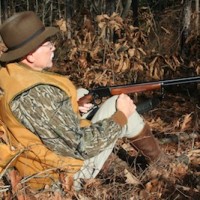
Faint praise would be grossly inadequate. A mindless cliché would be wholly insufficient, irreverent. Most likely spoken with no depth of thought, that often heard It could be worse would be an affront. None of these; not for this day. This day was spectacular, its perfection melding with a lonesome fog that resisted the sun and gave naked oaks to the east a more foreboding appearance than normal. January; 48 degrees; sunrise; exhaled breaths puffing and pushing a gentle cloud into windless surroundings; no noise save the symphony of nature. Spectacular.
I sat alone, ideal for such activity. In pretense I was squirrel hunting, but I probably wasn’t. Attire was basic, the type dress promoted by such a setting. The most significant piece was a tan game vest. It was the last my uncle bought and used extensively, but it remains functional. He was a simple man, asking nothing more in recreational tools than a cane pole and barely reliable bolt-action shotgun. He died in his early 80s almost 10 years back. I have had the vest since.
And then a sound, one that never fails to transform the present to some distant past. A pileated woodpecker. He first chattered and soon came bouncing by in that up-and-down flight pattern. He stopped on a tree and was immediately joined by two more of his kin. It is this bird I most associate with similar mornings as this in the squirrel woods with my dad. I was at first alarmed by that raucous call back then, but my dad assured me, explained what I was hearing. Can it possibly be that was more than 50 years ago? Alarm has since morphed into solace.
The rifle in my hands was a classic, a Marlin lever 39A .22. This basic platform has been in production going on 100 years now, and though the one I held had cosmetic changes, the .model remains pretty much as it was at its introduction. I wanted one throughout childhood, but finances would not allow. That desire never faded, so I treated myself not too many years back. No buyer’s remorse. The little rifle proved more than I had longed for since l was 12.
With the sun now forcing misty fingers through the fog and between bare limbs and around sturdy trunks of oaks that were waiting patiently for spring and new birth, a pair of wood ducks whistled by. A flock of geese honked from high overhead. A single-file string of does nibbled along, unaware of my presence. One suspected something and did that head-bobbing maneuver in my direction. She concluded, if indeed she did see me, that I was no threat. Her conclusion was correct. They pattered quietly on damp leaves and melted into a pine plantation.
And there were squirrels. One in an oak nearby, five or six bouncing around the treetops over there to the right. But actually taking one or more of these gradually became a matter of less import than I had envisioned while driving to the woods earlier. I was content to watch and think and find great refreshment in the moment.
I considered some words of Solomon. You know those from Ecclesiastes where he, a wealthy, powerful man possessing every material thing he could want and experiencing every perceived pleasure that could come to mind, laments, “Vanity of vanities,” this from the King James Version. The New International Version translates it “Meaningless! Meaningless!” Solomon goes on in this same thought process to say, “What do people get for all the toil and anxious striving with which they labor under the sun?” – Ecclesiastes 2: 22 (NIV). Strong words demanding thought. I thought.
Here I was experiencing a prodigious supply of unexpected gifts. None of them required “toil and anxious striving.” They were gifts. Foolish I would be not to recognize them as such and grasp each for what it was, allow them individually and collectively to enrich and energize my life that, like the life of everybody else I know, is filled with daily struggles and fatigue from the mundane. This perfect day in the squirrel woods was running my cup over with rich rewards.
Perhaps, either literally or figuratively, there is a tan game vest in your closet. Perhaps there is a vintage .22 collecting dust in a corner. You might consider dragging out these items from the past and making them a part of the present and future. A perfect day could be hidden in them.
Venison & Gravy
Cut pieces of venison loin or steak into pieces about the size of three fingers. Lightly batter and brown it. Place the browned meat in a crock pot and add a package of dry onion soup mix. Following the instructions on the package, prepare a brown gravy mix and pour over the meat. Cover the pot and cook, adding water if more gravy is desired. If time allows, cook this on low for most of a day. Serve with rice or potatoes.
 Tony Kinton is a native Mississippian, where he grew up on a small farm. Hunting and fishing were regular parts of his life, and these pursuits produced much of the food found on his family’s table. Read more here...

Wagon Road Trilogy
Book 2